

Wilhelm was born in the sprawling slums of Berlin. He didn’t see the sun past the hazy black sky until he was thirteen, when the North Winds howled hard and long, beating back the smog for twelve days and twelve nights. But by then its embrace did nothing, nothing but burn his skin and sear his eyes; it was nothing but blinding.
The Cardinal in the seat of Saint Boniface called it a miracle; six months later, the Holy Father in Rome agreed. A canonized miracle. What a miracle. Those winds blew out power to a third of the city, that sun beat down on temperatures miles below freezing. Last Wilhelm heard, four thousand men, women, and children died, frozen, huddled in their homes for that miracle. Some three hundred and thirty-three a day. Double that and you’d have his opinion on that matter.
His father died in the trenches of Bohemia when Wilhelm was eleven. His mother in that miracle. A ward of the state they called him, all of them, the lost sheep, the children of the twice martyred. An orphan, loved only by the Mother Church, by the Lamb of God and none other.
So His number need not be called, the draft need not claim his soul, for it more than any other belonged directly to Berlin, to the Kaiser, to Rome. So from thirteen on, he knew discipline and deprivation; he knew only faith; he prepared for martyrdom, for service to the Holy Church was the only guiding light a man ought to need.
They brought him to the countryside, where he saw the sun at least two in every three days. Blue above, clouds of heavy grey, blown in from the cities. He wondered why, why would they live in the mire and filth of their collective lives. Why would men make a world like this? Why would they sully God’s creation? To fight the damned, they would say, surely, and yet the great gift He bestowed had been sacrificed upon the altar of victory, ever illusive. A price agreed by generations long gone, paid by those still living in perpetuity. The sins of the father upon sons down an endless stream, guilt forgotten, only duty.
Prussia didn’t make warriors, Prussia made soldiers. The difference? Discipline. A warrior’s greatest strength is his ability to kill; a soldier’s is his ability to follow orders. Plenty are willing to kill for their beliefs, shed blood for God, but it’s rarer that a man be ready and willing to die for the same. To shed their own blood in service to the Godhead, to be the Lamb of the Lord, not the knife.
Not that the men of Prussia were trained to accept their fate, no, they weren’t trained to die for their country; they were trained to make some poor bastard die for his. Yet still, they had to carry the guilt of the fallen, to be ready and willing to pay the price in blood.
When the training ended and he received his stahlhelm, Wilhelm found himself a man of the Sturmtruppen. The gold bar upon his breast, the feather in his cap, the silver tassel at the hem.
Wilhelm had long dreamt of graduation, had long dreamt of taking the helm, of donning the uniform, of being lifted as he had seen others lifted before him. But the day it came, the early morning when he took his helm and donned his uniform, there was no uplift. The Chaplin anointed him in ash and oil, and he was born anew, but felt just the same as he had before.
He had a dream, a fool’s dream, of serving at the front in Bohemia. A little boy’s dream of avenging a father slain. Shattered when he received a posting with his new rank, the Eastern front. Wilhelm was to be stationed alongside Prussia’s allies in the Rus, by the River Volga, on the border of the great expanse.
So he bordered the iron horse east along the Carpathians, through the dismal Pripet Marshes of the Polish frontier, into the Russian Uplands and beyond into the Hill Country of the Volga. The train cut its way across the countryside, great iron tracks that rounded their way over and across the land, like veins pumping through the continent.
The cabins were packed end to end with freshly minted Sturmtruppen, as himself, alongside conscripts bound for the front. In times of peace, most would end up errand boys, cooks, and the like. Professionals, most of them wards of Mother Church, outnumbered conscripts some two to one. A sign of peace, fleeting as it might be.
He spoke to no one, and neither did he listen. Instead busying himself with pale blue eyes fixed on some distant horizon beyond the tram’s window. The land of his country first, the flat fields of the German heartland, home to a hundred princes and one. The land was dotted, even from his passenger seat, by the billowing black pillars of smoke rising from the many cities of his homeland. The many cities of the Holy Roman Empire, or the carcass of it that had limped awkwardly into the twentieth century.
Sunflowers standing tall, turning the whole of the land into a yellow tide, bright as the sun might have been in the days before the Fall, before the First Seal was broken. They were in full bloom as September loomed high before them, and the winter months past that. Reaching for the skies, golden petals open ended like hands splayed abreast in reverence of God Almighty. By them fields of oats and barley, hardy crops for a hardy land.
It was said a hard land made for harder men, like to like that made sense, strength to meet strength and a thick skin to survive it. But Wilhelm hoped that was the talk of beggars and fools. For while true Prussia was no Eden upon the earth, it could not hope to match the lands further north and east for suffering and deprivation inflicted upon their people. The lands of the last pagans upon God’s country made their homes on the freezing Baltic. Not to forget about his destination, about the lands of the Slavs, king among them the men called Rus, with the blood of the Norse pumping through their veins.
The land of the Poles came in the days to follow, as that iron horse charted its course; great acrid plumes of smoke belched forth, like the wheezing of some odious beast. These were rich lands at the start, with endless fields of amber wheat near ready for the reaping, for fear of an early frost. Soon, though, two days on or so by Wilhelm’s judgement, they passed out into the marshland of that frontier.
A place of haunted ruins, separating east and west. Tower trees gone to rot, half collapsed into the mire, slowly petrifying in the bog. The people of these lands were said to be a queer lot, where the east and west met entwined. Home to White Russians, Ukrainians, Cossacks from east of the Dnieper, even the odd rural Jew. Or so the debrief had told him. But one might find older things in swamps like that.
The thought of it turned his stomach. A man of Prussia needed only two things, blood and iron. Anything else was an extra at best, or a burden at worst. There were worse things than magic in this world, but in that moment, looking out on the blackened marshlands, he could hardly think of one.
They crossed the Dnieper, and made speed across the Uplands, rolling endless fields of amber wheat, the great breadbasket of all Europe. At least when it wasn’t set ablaze, or frozen solid, come the winter months. They kept that momentum into the hills of the Volga, all the way to Tsarisyn, the City of Heroes by the Volga. Central command for the eastern operations of the Rus, his new home.
Travel down the riverside was tedious; a summer snow drifting in from the northeast dusted anything that didn’t retain the heat to melt on impact. The riverfront was no scenic cruise liner’s dream. It was a fortress, birthed of the last Great War endless tracts of bunkers, built over some two decades. A maze where the men of the City of Heroes and the surrounding countryside lived and died.
Wilhelm had heard it told that these trench lines had entire residential districts dug beneath the earth, schools and churches, gymnasiums and training grounds. Even factories, so as to keep the men of that living fortress prepared. An ancient idea made new, inspired by the great subterranean cities of Anatolia, known since the days of the Pharaohs, now home to the last Christians in Asia Minor.
Why were men like that? They fought and died, as new technologies and tactics tore them apart, one to the next, always the same. Only to perfect the tools of one war, just in time for them to be obsolete in the next. Still, it was hard to imagine an earthen fortress guarding against amphibious assault could be obsolete.
The whistle blew as they pulled up to the city; the crumbling ruins topside, the deep scars left from the incursions halfway through the nineteen tens, were abandoned. So they guided them under the city. Even here it was all interconnected, a great maze of tunnels, where a man could be born, live and die without ever seeing the sun. In that moment it seemed no wonder the briefing had called them Mole Men of the Volga, though he dared not say that to anyone’s face.
His host was a man as tall as he was wide, a Sergeant by the stars on his lapel. With big, ruddy cheeks and a thick, long mustache gone to grey. The style and form of which revealed him a Cossack, despite the formal uniform that labeled him a man of the Tsar’s regular forces. “Privyet, kak dela?”
“I am Sergeant Bauer.” Wilhelm had only one name at birth, but upon taking the uniform he had been given a new name for the record. His hair a mouse brown so as Bauer seemed appropriate to the stenographer. “I must inform you, I don’t speak Russian, Balachka, or any of the eastern tongues, I do speak Polish, though I imagine that means little and less east of the Dnieper.”
“Oni prisylyayut mne glukhonemogo cheloveka?” The red-faced man laughed, turning to those around him, in similar dress and fashion, one another Cossack and the other clean shaven, with a knight’s mail beneath the folds of his uniform.
Wilhelm frowned. “I might not speak Russian, but I’m not blind. As an officer of the Sturmtruppen I demand proper accommodation.”
“Yes, yes..” His host laughed. “My German is not so good, but I say we will make good friends here and on, yeah? Yes?”
“Yes.” He replied, though Wilhelm had his doubts. “I hope for an amiable working relationship.”
“Da!” He smiled, taking Wilhelm’s baggage off the tiled floor of the old topside train station. “I am Vladislav Sotenko, Sergeant Vladislav Sotenko, as it pleases.”
The pair walked out together, followed closely by Vladislav’s two henchmen, and further still by the gaggle of troopers that young Wilhelm was meant to command. “You are early sadly, in a few months they’ll have finish, how you say, underground line?”
“Subterranean.” Wilhelm corrected.
“Da, subterranean, it’s good yeah?” He asked. “In and out, without being exposed to the enemy. Then we be a fortress without penetration.”
“No fortress is impenetrable, Vladislav.” Wilhelm replied curtly.
“Yes, well, you will experience this and share your thoughts, after not before.. Sergeant.” He added the last as an afterthought.
“Do you have an issue with my rank, Sir?”
“I have an issue with inexperience, green, yes? Mr. Bauer?” Vladislav waved a hand dismissively.
“Sergeant Bauer, Sir.”
“Yes, we do not make- How you say, green meat into command.” The Cossack shrugged.
“I’ve been training for this for nearly a decade, Sergeant.” Mechanical, stern with all the iron he could force upon it.
“Yes, but training is not living.”
“Yes, the Great War, no doubt there will be more-”
“More? No, the Great War never end, no beginning, no end. It simply is.” The Cossack laughed.
“Surely even you can see the difference, smoldering conflict along the borders and open war?”
“Maybe in your Berlin, in your Rome.. Here? On the Volga, on that border as you say, the war does not end. Here the war is eternal.”
Wilhelm gritted his teeth. “Apologies.”
“No need, you are here now.” The Cossack replied. “War is eternal for you now too, da?”
“Da.” He replied flatly as they descended into the depths of the tunnel works. Hundreds of miles, carved through earth and stone, reinforced with rebar and concrete, wooden scaffolding and packed earthen works.
The most densely populated tunnels were like a city spoken into existence, each concealed from the whole, separated. But the sounds of it, of life echoing in the deep, revealing the true extent of this Hero City. The ruined land above, mirrored now below. Hospitals, kitchens, factories and schools, humming in tune.
The old, the young, the smell of ash and oil, of produce and meat in the market, the laughter of children and the echo of gunshots. Here, below the earth, sound was amplified, echoing loud and long. Making even a small community cast an outsized shadow, and this place, this city by the Volga, was anything but small.
These areas were lit by overhead fluorescents, built into the ceiling, or hanging precariously. “Not bad, not bad for a mole’s town.”
The Cossack laughed, cheeks redder beneath the earth than above, despite the dearth of wind. “This is civilian grade, yeah? Ours is up ahead, further afield.”
“Right, of course.” He eyed the tunnels as they narrowed, commercial and residential space giving way to transit, narrow tunnels running in a dozen directions. Tile and stone floors replaced with hardwood set in packed earth. “Why move it beneath the earth?”
“Defense.”
“Obviously, I mean the civilians.”
“The same, you saw what happened to the old Tsarisyn, on the surface? The same will not happen again..” He tugged hard against his whiskers. “An iron rain, cannon fire, artillery, and worse-”
“What could be worse than all that?”
Wilhelm caught a twinkle in Vladislav’s eye, and the Cossack answered plainly through his yellowed grin. “This is why we don’t make officers of fresh meat, you will see, German, you will see.”
The walls were thickest closest to the border, narrow corridors wide enough for a man abreast, a maze of covered and uncovered tunnels and trenches. Mess halls, small arms factories and barracks. Vladislav claimed this quarter of the line could operate completely cut off from Tsarisyn proper for six months. And Wilhelm couldn’t help but believe him.
Berlin had its bunkers and bomb shelters, of course, he had seen the earthworks near Slovakia and the infernal infection therein. But this, this was a different beast altogether. In scale, if not in design. Birthed not of wealth or technology, for this land held neither. Built of blood and toil, a collective shame at man’s inborn guilt. The dame, holding back the damned.
Dinner was shared in the mess, men of all ranks and titles scattered to their nearest dining tables. A thin soup, blood red, with stringy cuts of fat and gore, alongside carrots and turnips, served above a bed of half mashed potatoes. “Do you like, da?”
“Da.” He mirrored, lifting a spoonful to his host. It tasted of bile drawn from a corpse, but he struggled to keep his composure. “Good..” Wilhelm coughed, he and his men light from the fair.
Of course, Wilhelm finished every bite. It didn’t matter if he hated it; it didn’t matter what it was. A soldier of God needed his strength; comfort was a luxury a Prussian Sturmtruppen could ill afford.
The Sturmtruppen under Wilhelm’s command were assigned beds by the artillery. Dugouts and concrete pillboxes at the back end of the lines, open to the air. Cannons both great and small, silent pillars of dark iron and steel. “Why are we to be stationed by the artillery, Sergeant Sotenko?” He asked. “We are not a proper fire team-”
“No, you are right where you ought to be. First to hear, the fire in the night, not close enough to the Volga herself to be the first to die.”
“I must lodge issue, as Sturmtruppen we ought to be in the vanguard of any-”
“We are not playing at war, Mr. Bauer, and you aren’t anymore either.” The Cossack frowned; mirth fled and gone. “Would you rather be at the river front, first to die? Or the middle last to know? You are right where you need to be, you and your men alike.”
The trumpets sounded at dawn, and his ten Sturmtruppen joined with Vladislav’s twenty Rus. As they mounted the surface, out into the open air, under that sickly grey sky, and the Volga, a slow stream of black sludge creeping south ever on to the dying ocean.
They made for a strange partnership. The Prussians, in pressed uniforms, armored in blackened Enochian iron. These men, his men, in their stahlhelms pinned up with formal professionalism, faces clean shaven and hair pulled back. Carrying the black cross of the Teutonic Order, standing face to face and side by their side with these strangers, these Rus. Natives of the Volga dressed in hand-me-down suits of rusting mail and ratty, faded surcoats with the two heads of the Tsar’s eagle upon their breasts.
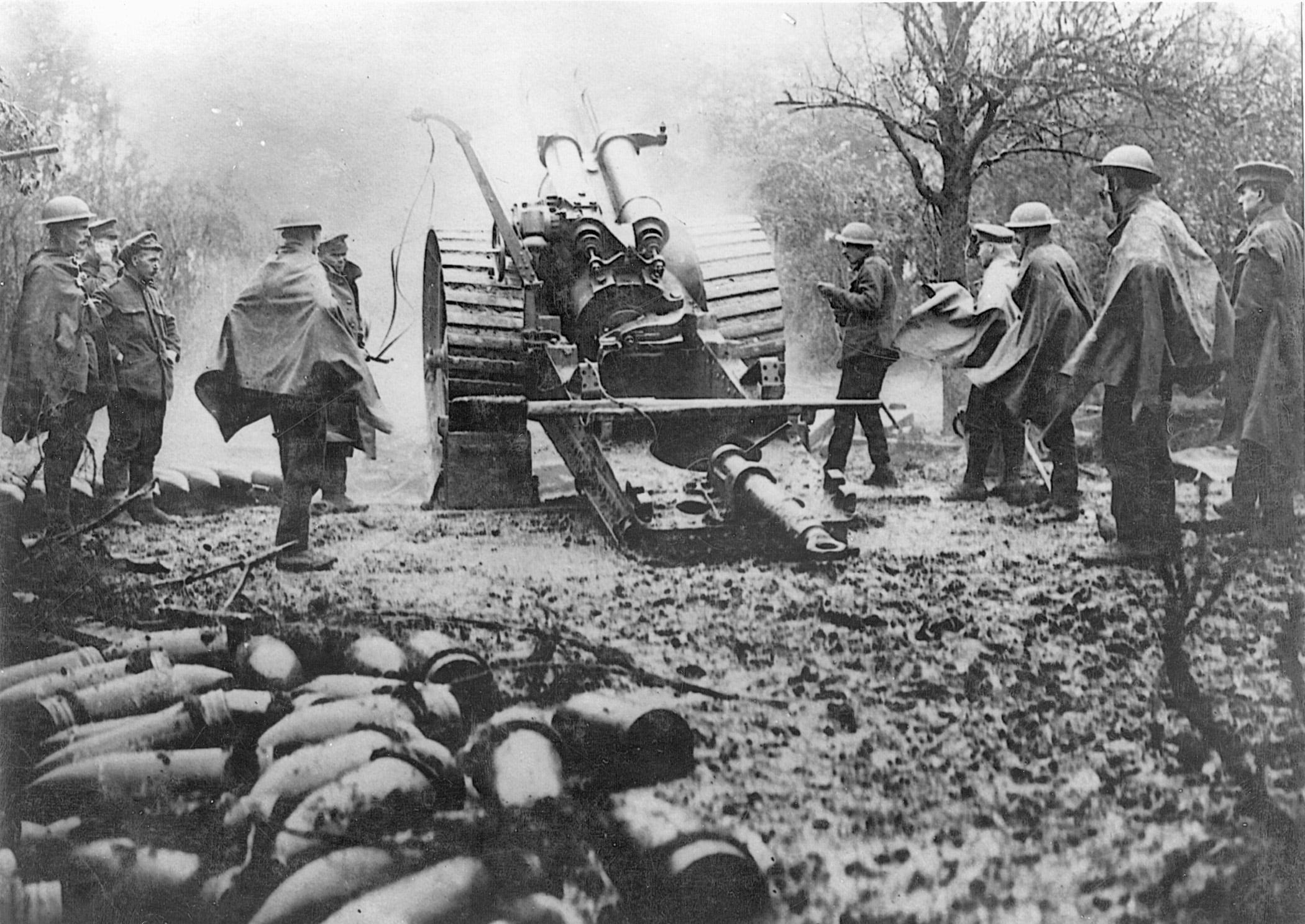
The Prussians were cradled in power harnesses, like the exoskeleton of an insect, armed with trench knives and hand selected guns for specific purposes, from rifles to shotguns. Enochian Iron, thrice blessed, thirst quenched in holy water touched by the pontiff maximus himself. Their counterparts were not; chain mail barely holding together, wooden shields closer to relics than proper military equipment. Each hand carved, with icons painted on their forward faces. God in all his forms, Mary the Mother of God, or Saints like Abraham of Bulgaria and the Blessed Simon of Yuriet.
Grenades on bandoliers, hammers with explosive tips against the flat end, javelins with grenades bundled at the tip — nearly all of them possessed the means to kill in an immediate, grisly fashion. These superstitious yokels carried what they claimed to be reliquaries and blessings, tied off by their necks, sheltered beneath their coats, housed within their shields. If they were all legitimate, their squad alone would have enough bones to rebuild a Saint whole. Yet better that he not mention it; if their faith brought comfort, if it brought victory, who was he to judge?
Their Chaplin was a bigger problem, with green vestments over his chain mail, polished to a sheen and trimmed in gold. He carried a cross on his back, carved of hard wood and old as the decrepit man carrying it. His hair, white as the summer snow on the countryside, was long, beard and head both.
They were all Catholic now, and had been for generations untold. But in this moment of introduction, he felt a divide between them. It seemed here in the East the memory of the Roman Schism ran deep, with loyalty to the Pope interceded upon by the Emperor of all the Romans and his Patriarch.
“If this place is so impenetrable, why do we go on patrol?” Wilhelm asked, trudging through the mud by the banks of the Volga. Smoke rising from the maze of bunkers and pillboxes.
“Who do you think makes it impenetrable?” Vladislav laughed, cheeks red from the early winter winds, blowing snows south out of turn. “Walls are useless, useless without men to man them, without strong arms holding sharp blades and sharper wits.”
“As you say, Sergeant.” Wilhelm agreed. “But this place is after all a fortress, would they not need to.. assault it in numbers?”
“No, think of the trenches like a.. sieve, yes.” He tugged on his Cossack’s mustache. “It catches the big bits, but the little things, they can slip through the cracks, come out the other side.”
“Clean up then?” Wilhelm hummed. “Yes, better not to rouse that Great Beast of war, to fire thunderous cannon, to expend strength best kept close at hand.”
“Indeed.”
“But the war is a decade now done, surely-”
“Do you think the jaws of hell remain closed? That the infernal gates ever tire?” He shook that round, red face. “No.”
“And yet peace their infernal masters made.” Wilhelm knew of the war’s end, the treaties, when the guns fell silent, mostly at the least.
“The Serpent has many heads, and not a brain among them.” The Cossack explained. “You can make peace with nations, but not ideas, Mr. Bauer. There are demons and damned that do not fall under the command of the multitude states of Magog.”
“So it would seem.” It must have been a month of patrol duty before they made contact with the enemy. The sun half set, near ready to return for dinner and a cold bed.
Then it came: a pack of demented lupine monstrosities. Man and machine, beast and demon, all in one. Twisted flesh, stained teeth, and rusted iron. Eyes glowing red in the dying light, children of Wrath’s head from among the Seven, Satan, the Prince of Power.
They seemed to bear untold levels of pain, moldering piles of flesh and bone, growing and bending, breaking and rending. As they were born and reborn and born again, forever and always. They barreled through their troops, only three of them, but that was enough to match thirty true born servants of God Himself. A flurry of gunfire, the crack of bullets like thunder, and the rending of tender flesh.
Wilhelm had trained all his life for that one moment, yet in it, his vision clouded and his thoughts turned loud, blinding. The rusted teeth and gnashing jaws, tearing through men as easily as one might tear their dinner. Filling their stomachs with saccharine sweet meat, jaws dripping wet with a crimson touch, soaking through the cold earth at their feet.
These were the children of Hell, the ones that kids were taught to fear in the crib, the ones that would have, had long since destroyed the world. They took nine lives before even one of theirs fell; every shot and slash, all of their efforts healed in a moment’s time. The tenth to die enacted his price, some Russian with a lazy eye, pulled the pins of the grenades out of his lapel, and blew the creature back to hell.
The second was run through by Vladislav, a lance affixed with a grenade at its end, not enough to kill it, but enough so that a Sturmtruppen flamethrower could do the job. A weapon for every scenario, and the means, the will to use it. The third was surrounded, beaten senseless, until its healing stalled out, and a dozen knives, and shovels, and blades, and mauls left it a quivering pile of broken bones and pudding flesh.
They had set out as thirty-two men that morning, counting themselves among the number, but that night they returned twenty-two breathing alongside those ten corpses, with half that number in injuries. With no time for recovery, they took to the mess for a meal, then the infirmary for mental evaluation.
The waiting room was tiled, white, and sterile. Men rolled in and out through the doors at the far end, while the rest waited their turn. What lay beyond for them and theirs remained a mystery to him, yet he waited. In a chill silence he had come to expect in times of trouble among these cold men of the Volga.
“Some men, some men go crazy when they see the truth of it, our enemy. Not the damned, the Infernite Legion, humans in service to the Beast, but those.. things. Flesh tainted by the seed of demon kind.” The Cossack explained upon their return, waiting in that sterile white room. “It’s got to come every time, da? A man can be fine a dozen times over, a hundred, a thousand.. Then one day, the wrong day, yes? Their back breaks, their mind gives way, their sense takes flight, leaving a corpse in all but name.”
“Oh..” Wilhelm felt the word in his mouth, as if weighing it. They had lost so many men in such a short time, would that time ran in reverse. “I suppose that is a blessing. If that there could be a glimmer of light in a tunnel so deep.”
“Let God Almighty be that light.” He was smiling, smiling, red cheeks and all. How could one let this roll off their back? How does one live after, after that? “Failing that the end of a bottle, da?”
Had the Cossack’s heart calcified? Had he lost so much, so often that death itself had lost its symbol. That death itself was nothing more than an inconvenience. “You seem calm, all things considered.”
“I may, if only for the ease of long practice.” He laughed.
“Bastard.. Bastard!” Wilhelm gritted his teeth, to laugh, laugh in the face of their sacrifice, their death. “You do not deserve their sacrifice! YOU do not deserve-”
“I seek nothing, need nothing, nor do I deserve it.” Wilhelm grasped him by the collar, but Vladislav made no move to break it; instead, he replied in steely certainty born of sacrifice. “Their lives were spent on God’s behalf, their blood shed for Him and the Tsar upon the First Throne in Moscow. Not for me, not for you, not for themselves.”
He sank back into his seat, small against the shadow the Cossack cast, a presence that dominated the whole infirmary. And with it, that pale white room swallowed him. What did it mean? If anything at all, that he ought to learn even at his age, that he ought to change, adapt?
“Tell me, what did you see?” The doctor asked, voice muffled through a black hook mask. Watched from behind pale crimson lenses.
“I told you three times.” Wilhelm gritted his teeth.
“Then tell me a fourth.” The doctor replied, softer then, almost imperceptibly so. “It is all part of the diagnostic test, Sergeant, please.”
“Three lupine men, or machines.. Or monsters..” Wilhelm cast eyes down from his seat mounted on the examination table.
“And they?” The doctor led, stirring memories of iron and crimson, and the forbidden saccharine sweetness of the flesh they offered.
“They ate them.”
“Who?”
“You know who!” Wilhelm snapped, pain behind the eyes, like a biting axe to the head.
“Sergeant..” He cautioned through those eyes of leaden glass.
“My men, our men..” He bit back his bile.
“How many?”
“Ten, ten brave men.. gone to God, in service of-” All of us. “Gone to God.”
“Alright.” The doctor jetted down a string of notes on a notepad. “It seems to me your mind is free from taint, for now. Know that you will see worse, worse before you return to His side.”
Wilhelm stood and made for the door. “Yes, Sir, I know.”
By the Grace of God they didn’t lose another; ten was enough, ten was more than they ought to bear. But that night, in his fitful sleep, Wilhelm was met by images of steely lupine eyes. Dreams of Serpents and sin, and the war born again on the horizon of his Mind’s eye, just past the banks of the River Volga.
Gatekeeping is lame. But you’re not lame. So don’t forget to share with friends. And thanks, for helping to grow our community!
Horror, Sci-Fi, Fantasy, e-read or audiobook, we do it all. For more original works from F.P. Dawe and readings from your favorite classics, subscribe below!